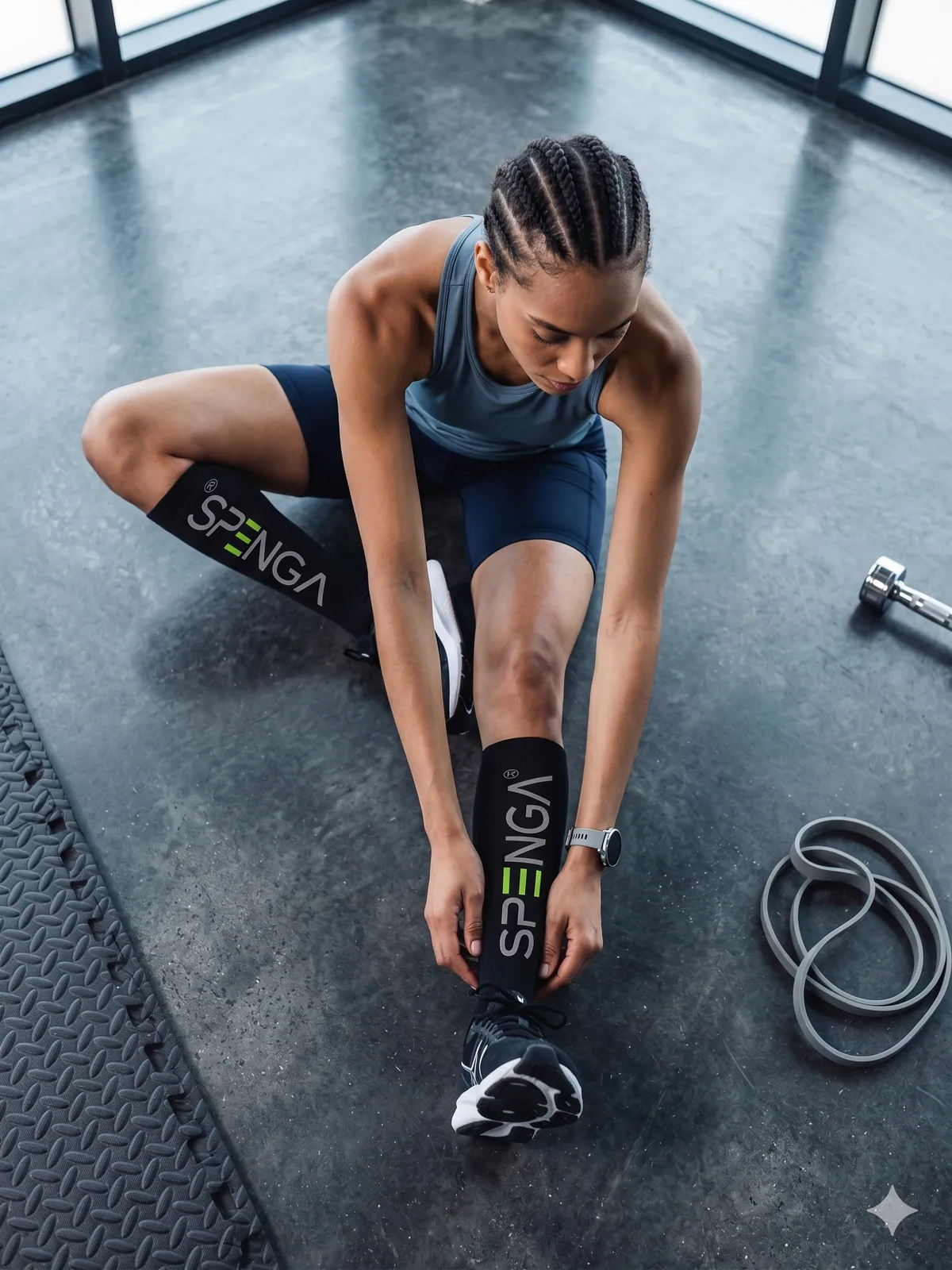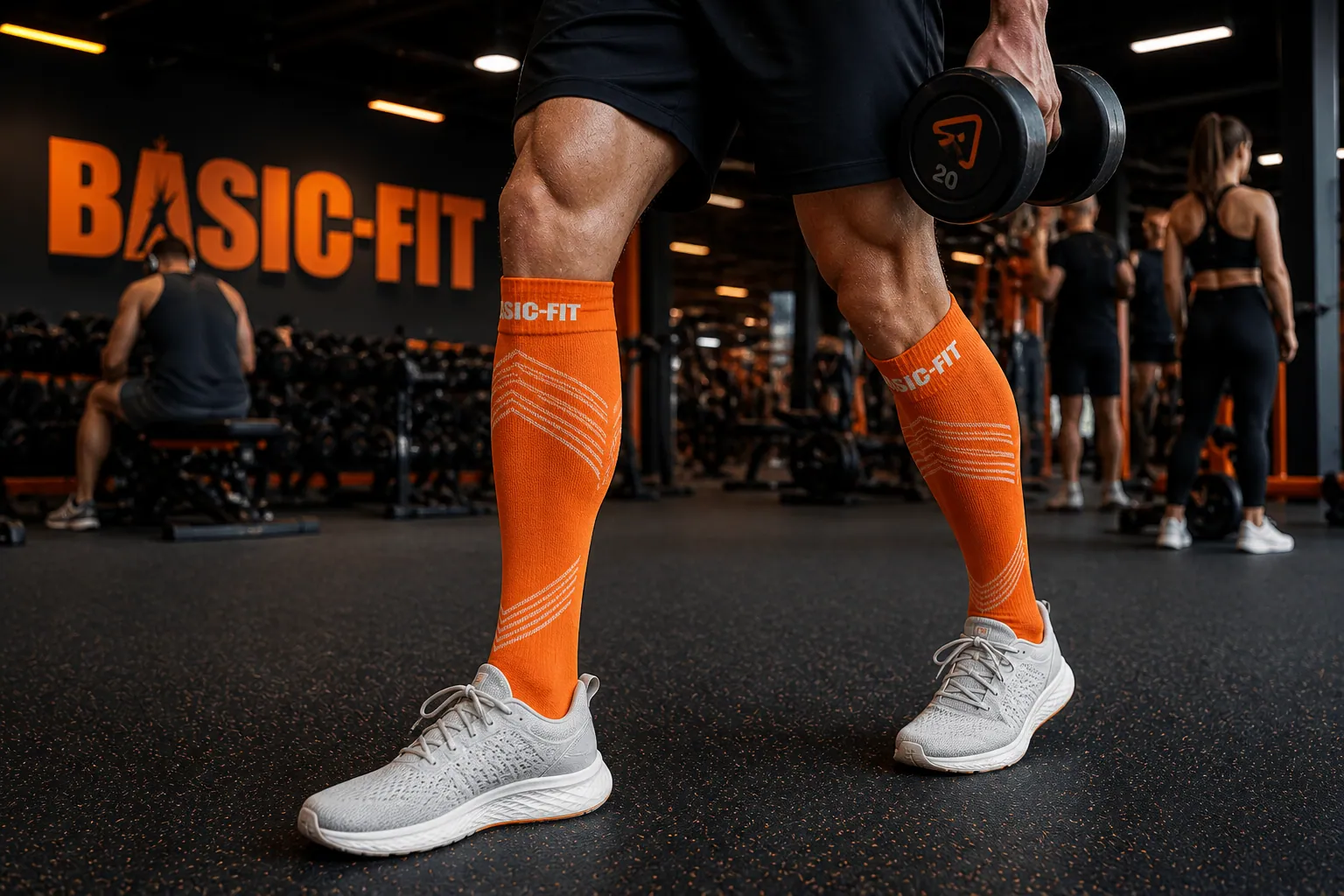
Most gym merch is a wash.
T-shirts cost €8–10, retail at €25–30, sell through at maybe 30% of inventory in the first quarter. Hoodies are better margin but slower turnover. Shaker bottles, water bottles, gym bags — all variations on the same problem: members buy one and never re-purchase.
The gross margin looks fine on paper. The actual P&L is unimpressive after you account for the dead inventory in the back office. Most gym owners eventually conclude that merch is a brand-awareness expense, not a revenue stream.
That conclusion is right for T-shirts. It’s wrong for compression socks. The economics work fundamentally differently, and almost no gyms have figured out why.
The dead-inventory problem with apparel merch
The reason a T-shirt has a 30% sell-through ceiling is that members already own enough T-shirts. They might want one as a souvenir, or to wear once during a competition. After that, the shirt is redundant. There’s no reason to buy a second one — and certainly no reason to buy one every quarter.
Compression socks are different in three specific ways:
- Members already buy them. Athletes who train hard typically own 2–4 pairs of compression socks at any given time. They wear out, get lost, get bloodied at races. Compression socks are a consumable.
- Members already pay €30+ for them. STOX, CEP, Compressport, 2XU all retail in the €30–45 range. The price isn’t a stretch — it’s the market rate for performance compression.
- Members keep buying them. Every 6–12 months an active athlete cycles through old pairs. Branded socks slot directly into that re-purchase cycle.
A T-shirt is a one-time souvenir. A compression sock is a consumable in a category where the customer is already buying €30 units multiple times per year. The economics aren’t comparable.
What members are paying for STOX right now
If you don’t already know this, walk through your gym tomorrow morning and look at what’s on people’s calves. In a gym with 400 active members of any seriousness, you’ll typically see 60–80% wearing compression socks during long sessions or after.
Annualized, your average athletic member is probably spending €60–120 per year on compression socks. If you have 400 such members, that’s €24,000 to €48,000 per year in compression-sock spend leaving your facility for STOX, CEP and Compressport.
Capturing 60% of that — even at the entry volume tier — puts a six-figure annual revenue line on your books. With zero ongoing operational cost beyond the initial design and stocking the merch wall.
The math on a first batch
Take a real example: a 500-member CrossFit box that orders the full S/M/L set.
First batch:
- 100 pairs each of S/M/L = 300 pairs total
- Cost: ~€4,500 (€15/pair at the 100/size entry tier)
- Retail: €30/pair
- Conservative 60% sell-through over 8 weeks: 180 pairs sold = €5,400 revenue, €2,700 net margin
- Optimistic 80%: 240 pairs sold = €7,200 revenue, €3,600 net margin
That’s the first run. The numbers compound from there because:
Second batch (reorder):
- Most gyms reorder at 250+/size to hit the next volume tier
- Cost drops to €14/pair → 250 pairs each S/M/L = 750 pairs at €10,500 cost
- Retail: €22,500
- 60% sell-through: 450 pairs sold = €13,500 revenue, €7,200 margin
By the third or fourth reorder, most gyms are ordering 500+ per size, which drops cost to €12.50/pair — €17.50 margin per pair sold at €30. At that scale, you’re typically clearing €15,000–25,000 net per reorder cycle, with reorders happening every 2–4 months.
Annualized: a serious gym typically lands at €60,000 to €120,000 in net margin per year off compression socks alone. For an asset that takes 30 minutes of design time and a single SKU to manage.
Why custom matters (vs. wholesale resale)
You could resell off-the-shelf STOX or CEP at your gym. Your margin would be ~30%. Your members would also see your gym selling someone else’s brand — every pair worn would be free advertising for STOX, not for you.
Custom branded compression flips the equation:
- You own the brand impression. Every pair worn is your gym’s logo on display, in the gym, at races, on social media.
- Margin is 2–3× higher. €15–19 net per pair instead of €8–10.
- No comparison shopping. Members can’t price-check your custom sock against an Amazon listing — it’s exclusive to your gym.
The cost of switching from “carry STOX” to “make our own sock” is small. The downstream brand and margin impact is large.
What the design process actually looks like
The hold-up for most gym owners isn’t the economics — it’s the imagined complexity. They picture three weeks of designer back-and-forth and a setup fee.
In practice it takes about 15 minutes of the owner’s attention. You send your logo. You answer a couple of short questions about colors. One custom design lands in your inbox within 48 hours. You sign off — production starts.
Total elapsed time from first inquiry to first pair on a member’s leg: about 5 weeks. No setup fees, no design fees, no MOQ trickery beyond the basic 100/size production minimum.
What “covers 95%” actually means
The standard first batch is 100 pairs each of S, M and L. That fits roughly 95% of adult athletes:
- S (calf 28–36 cm) → most women, slimmer male runners
- M (calf 34–42 cm) → top seller; covers most male CrossFit and Hyrox athletes
- L (calf 40–48 cm) → larger calves, heavier athletes
If your member base skews heavily one way (mostly women, or mostly heavy lifters), you can shift the size mix accordingly. But the default S/M/L spread is what works for ~90% of gyms.
Risk profile
The downside of running this experiment is small.
- Capital at risk: ~€4,500 for a first batch, fully refundable if the design phase doesn’t land you on a final you like (you only pay on production confirmation)
- Time at risk: ~30 minutes of owner attention for design + ~30 minutes of front-desk time to set up the merch display
- Worst-case scenario: sell-through is 30% in the first quarter, you reorder less aggressively, and you still net €1,500 on the first batch with the rest as ongoing inventory
There’s no scenario where this loses money in any meaningful sense. The only real question is how big the upside is — which is determined by your active-athlete count and how long you’ve been ignoring the line item.
How to start
Start a design — one free custom design in your inbox in 48 hours, no commitment.
Or see the full price ladder if you want to model the math yourself first.