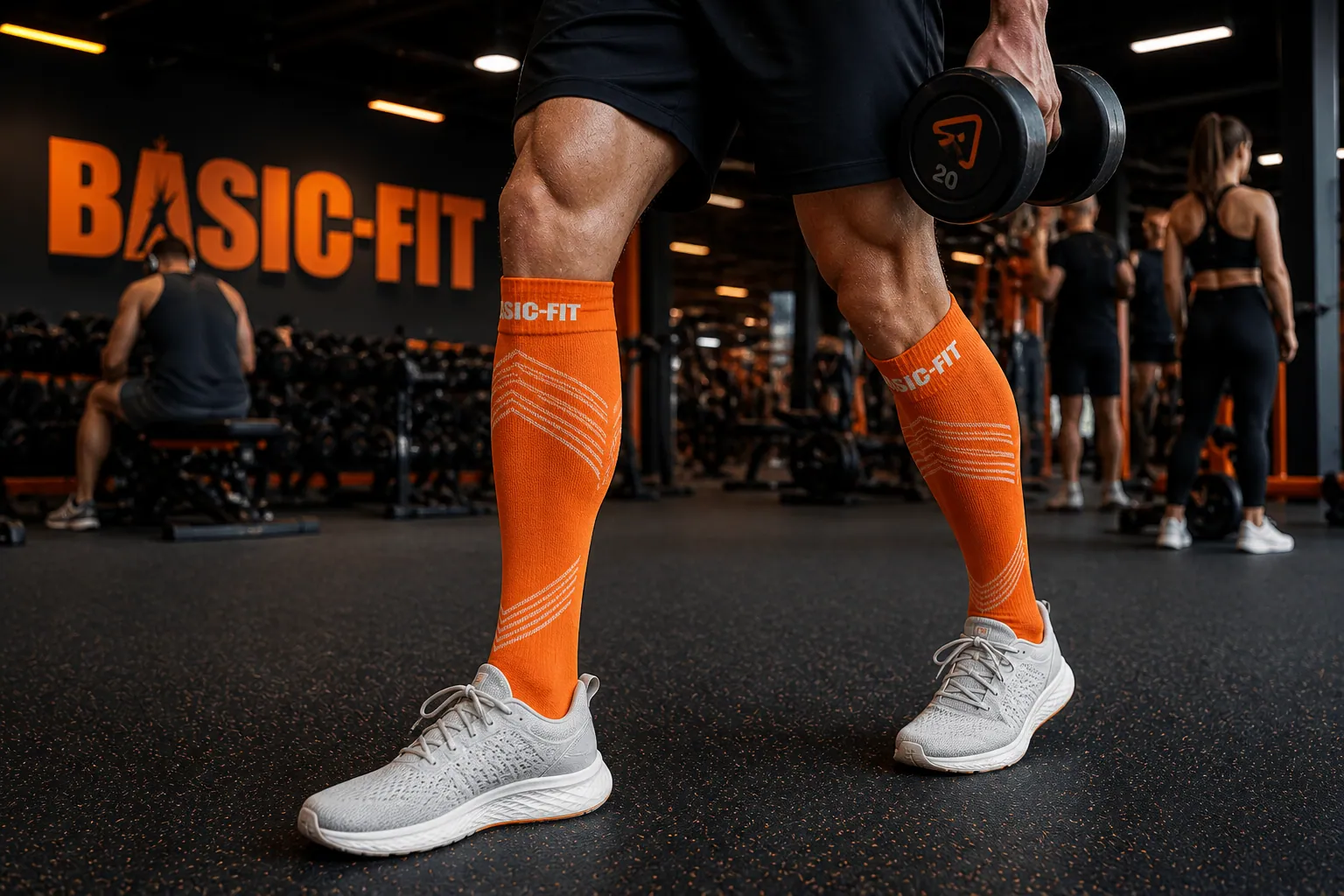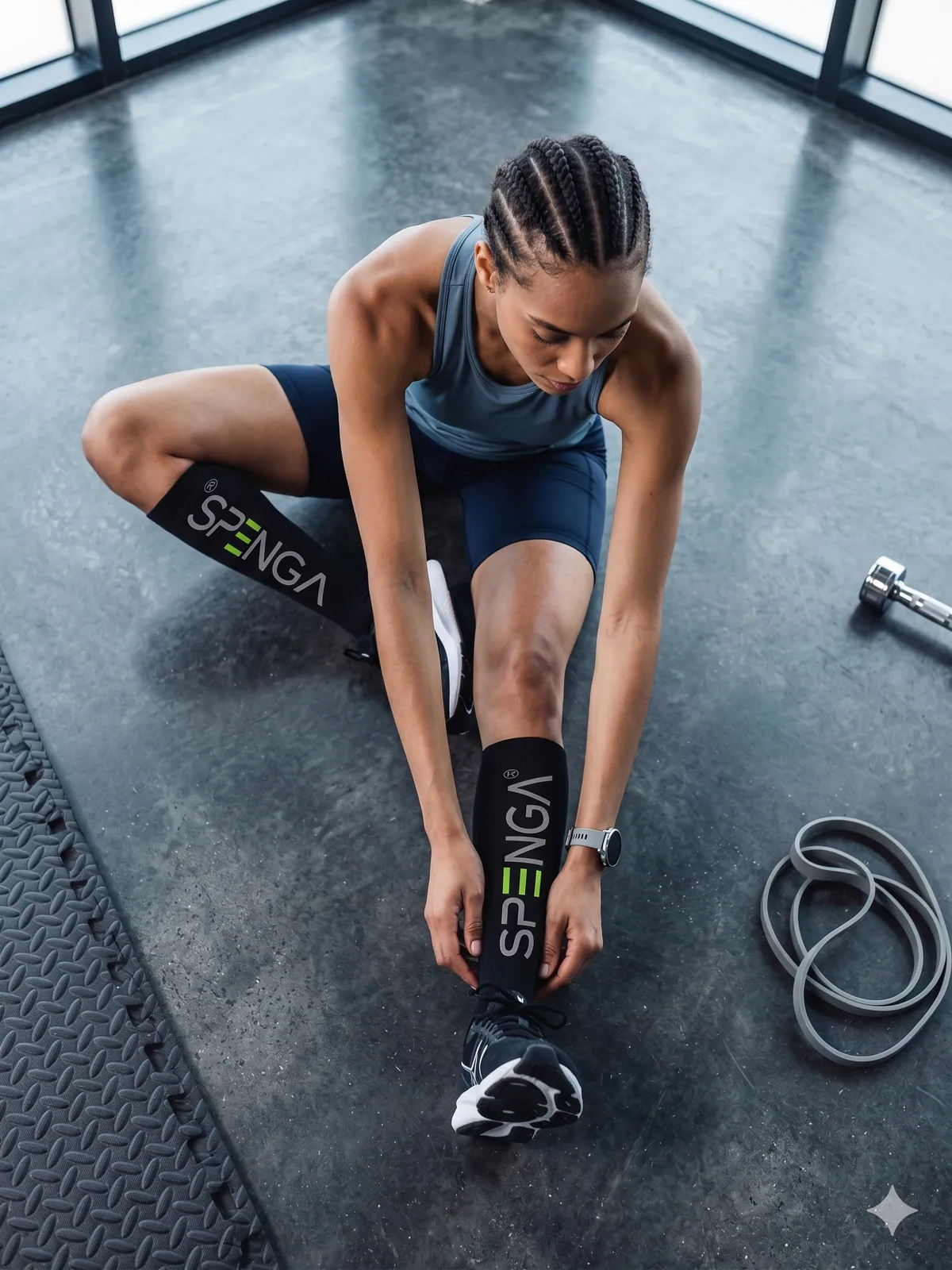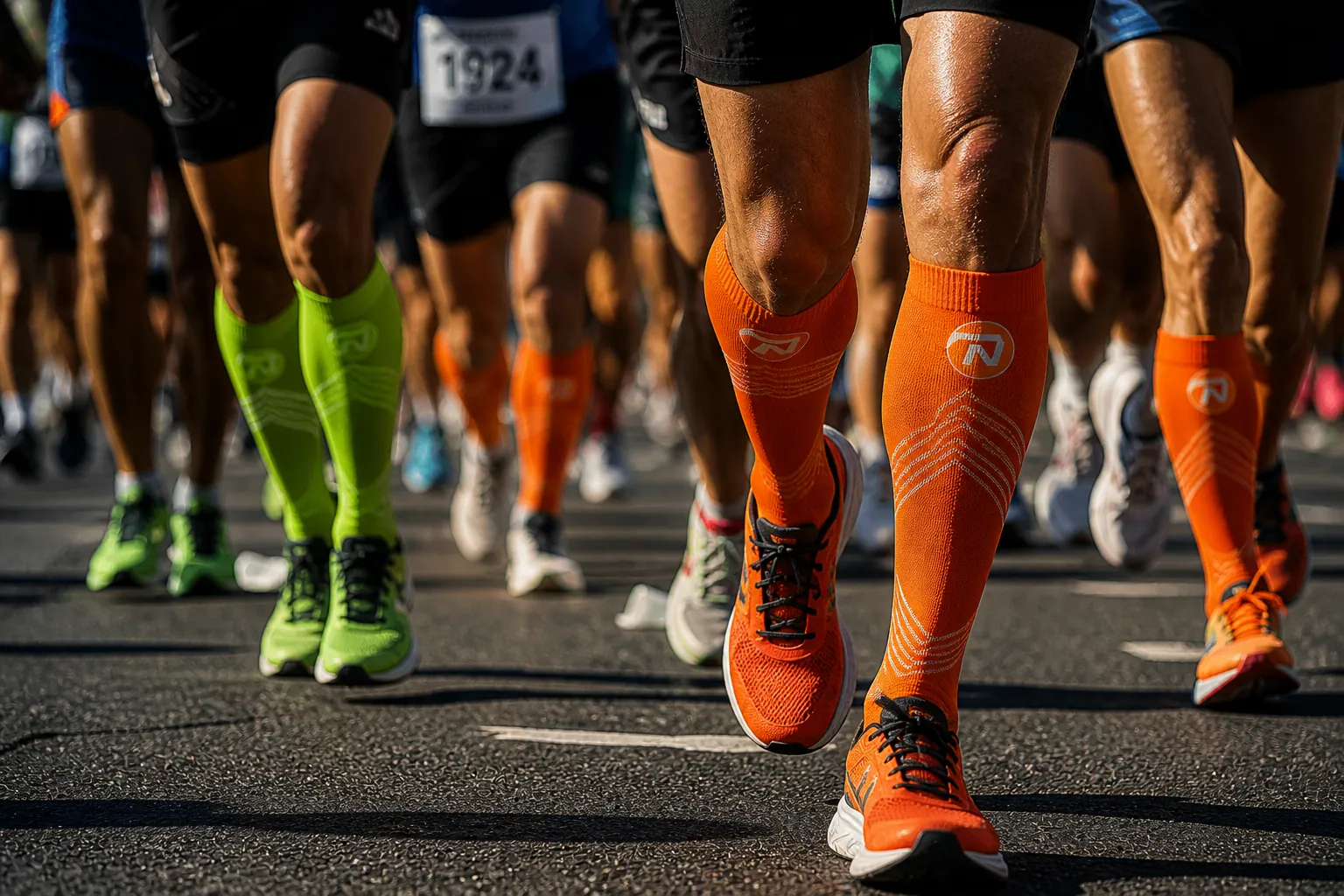
Walk into any Hyrox event in Europe — Berlin, Amsterdam, Warsaw, Madrid — and look at what athletes are wearing from the knee down.
It’s compression socks. Almost universally. STOX, CEP, Compressport, 2XU. The brands change; the category doesn’t.
Every athlete who walks past your box on race day, every finish-line photo that hits Instagram, every recovery-day selfie — that’s free advertising. The question isn’t whether your members will wear compression. They already do. The question is whose logo is on the sock.
If it’s not yours, you’re funding a competitor’s brand awareness with your members’ money.
The Hyrox visibility problem
Hyrox is a unique sport for box owners. Athletes train at your facility for 8–12 weeks before an event. They show up to the race in your kit because they identify with your gym. The race itself is photographed end-to-end — official photographers, partner brands, athletes’ own phones. Then those photos get tagged on Instagram for weeks afterward.
A T-shirt is okay. Members wear it once or twice. Then it goes in a drawer.
A compression sock is different. Athletes wear it:
- In every training session during the prep weeks
- At the race itself — visible across every finish-line camera angle
- On recovery days between WODs
- At other races and competitions for months after
You’re getting brand exposure in five distinct contexts off a single piece of merch. No T-shirt does that.
What “the sock” actually needs to be
For a sock to do the visibility work above, it has to be something athletes actually want to wear. That rules out most merch-grade compression socks immediately. They’re typically:
- Class 1 compression (8–15 mmHg) — barely above a regular sock; no real recovery benefit
- Polyester or cotton blend — slow to wick, holds odor
- Generic knit — visible seams, no anatomical L/R fit, blisters on long runs
Athletes notice this stuff in the first 30 minutes. They go back to their CEP or STOX, and the merch sock ends up in the same drawer as the T-shirts.
What works:
- Medical-Grade Level 2 (23–32 mmHg) — the same compression class clinically prescribed for venous return and post-exercise recovery
- Polypropylene microfiber blend — wicks faster, lighter, antibacterial
- Seamless circular knit with anatomical left/right
- Reinforced toe and heel for sled push and box-jump abrasion
- Knee-high coverage for shin protection on rope climbs
This is what competitive athletes already buy. Build your branded sock to that spec, and members start wearing it instead of their CEP — not as well as.
The economics
A typical European Hyrox box has 400–800 active members. Of those, perhaps 60% are race-prep training, 80% want compression for recovery anyway. The math, conservatively:
- Box of 600 members, 60% sell-through over 6–8 weeks = 360 pairs sold
- Volume tier: 250+/size unlocks €14/pair → cost ~€5,000 for 360 pairs
- Retail: €30/pair (the price athletes already pay for off-the-shelf compression) → revenue €10,800
- Margin: ~€5,800 profit on the first batch
- Reorders skip the design step — same 4-6 week production, no new design wait. Most boxes reorder before the first run sells through.
That’s a single product line generating the equivalent of 40+ new monthly memberships in margin, with zero ongoing labor cost beyond stocking the merch wall.
By the third reorder you’re typically at 500+ per size, which drops cost to €12.50/pair and pushes margin to €17.50 per pair. Pure exponential.
Why now, specifically
Hyrox is in its compounding phase as a sport. New events are being added in cities that didn’t have them two years ago. Every event is sold out months in advance. Every box that’s a Hyrox affiliate is fighting for the same prep-cycle membership share.
The brands that win are the ones that show up at race day on every athlete. Not on the start-line banner. On the athletes themselves.
Compression socks are the cheapest, highest-leverage way to put your brand on every Hyrox starting line in Europe — for the price of a single piece of inventory.
What “fully custom” actually means
A custom sock is not a generic sock with your logo printed on it. The sock should be:
- Your logo knit or printed on the cuff or calf
- Your colors on the body, foot, accent stripes — matched to your brand palette exactly
- Your packaging — your logo on the front of the box, your colors throughout. The only standard element is the wash-care info on the back.
- Zero supplier branding — nothing on the sock or box says “Compression Goods” or any other manufacturer name. 100% your gym, end to end.
If a sock supplier puts their logo anywhere visible, walk away. Members shouldn’t be reminded that the sock came from a third party.
What a first batch looks like
The standard first order for a Hyrox box is the full S/M/L set:
| Size | Quantity | Fits |
|---|---|---|
| S | 100 pairs | Women, slimmer calves |
| M | 100 pairs | Most male athletes — top seller |
| L | 100 pairs | Larger calves, heavier athletes |
Total: 300 pairs, ~€4,500 cost, covers ~95% of athletes. Ships 6-8 weeks after design approval. Sells through in 6–8 weeks for a 400+ member Hyrox box.
If you’re cash-conservative, start with 100 pairs of M only — that fits about 55% of athletes and lets you test the concept for €1,500. Most boxes scale to S/M/L on the first reorder.
How to actually start
The hold-up for most box owners isn’t the economics — it’s the perceived design lift. They imagine spending three weeks ping-ponging mockups with a designer.
In practice the design step takes about ten minutes of the box owner’s time. You send your logo and a few notes about your colors. You get one custom design back within 48 hours. Sign off. Done. The rest is production.
Free design, no commitment, no setup fees. If you don’t like the design, you walk away with no obligation. Start a design, or look at the full pricing first.